How Prudent Consulting’s Unity-powered digital twin stack is transforming operations across energy, offshore, and manufacturing

Shanti Zachariah - Unity Technologies
Senior content marketing manager

This Unity U/Day Houston presentation is by Rakesh Neunaha, CIO and head of global delivery, Bobby Doyle, regional sales manager, and CJ Kumar, technical delivery head, all at Prudent Consulting.
Over the past three years, Prudent Consulting has transitioned to using Unity Industry as its core platform for developing industrial 3D visual experiences and digital twin solutions. Unity's platform flexibility, CAD data integrations, and scalable deployment capabilities are some of the key advantages that won over the group.
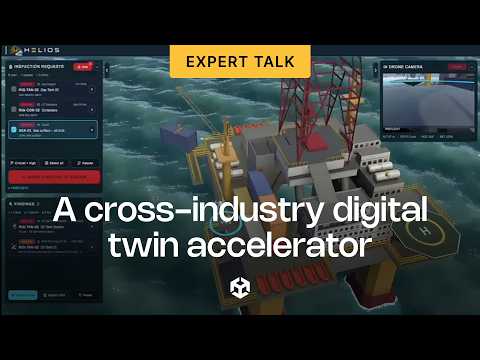
Their latest project is the Helios platform, which serves as a digital twin stack designed to speed up time to market their clients by standardizing components for asset management, process control, and infrastructure monitoring.
By ingesting CAD, PLM, IoT, MQTT, and enterprise ERP data, Helios can power scenarios such as remote drone inspection command centers on offshore oil rigs, operational walkthroughs for restricted manufacturing environments, and drag-and-drop network topology builders for IT/OT observability.
Key takeaways
- Prudent Consulting uses Unity Industry as its core platform for developing industrial 3D visual experiences and digital twin solutions.
- Their Helios platform is a digital twin accelerator stack for transforming operations across sectors like oil and gas, offshore, and manufacturing.
- Helios can deliver real-time 3D industrial applications like virtual offshore rig inspections, oil spill-rate analytics, and manufacturing plant walkthroughs.
- In their demo, one of the examples they show is of incident control wherein drone and robotic telemetry are used to execute pre-scheduled or trigger-based response missions via a remote command center.
- Prudent plans to expand Helios' capabilities with real-time observability integrations, AI-driven analytics, and immersive XR deployments.
Full transcript
Speakers: Rakesh Neunaha, CIO and Head of Global Delivery and Bobby Doyle, Regional Sales Manager, Prudent Consulting.
Notes:
- This is a lightly edited transcript of a recorded presentation.
Introduction
[0:00] My name is Bobby Doyle. I'm with Prudent Technologies. We are a software consulting firm that builds digital twins in a variety of different industries that we will showcase today.
[0:26] We've been a Unity partner for over three years now and recently became an implementation partner to help service our customers. We help build digital twins for training purposes, corrosion prevention, asset diminution, part ordering, and provide live visuals to inaccessible physical assets. The use cases that we will showcase today are virtual offshore rig inspections, thermal plant walkthrough, and network infrastructure. Now, I'm going to pass it over to our technical side, Mr. Rakesh Neunaha.
[0:57] Good afternoon, everybody. I oversee delivery for Prudent Consulting. As Bobby mentioned, we've been helping our customers improve their digital posture with digital transformation initiatives and helping build modern architectures. Digital twinning started off for us as part of that initiative. But it was a journey. We started working with a lot of customers on building
[1:34] 3D visualization experiences and also the precursors to what we now call digital twins. We worked with customers in the commercial real estate industry with smart space planning kind of solutions. Several of these are actually not on Unity. When we started, we were using other platforms in the space.
[1:58] Three years back, we got an opportunity to work with a customer in Houston. A couple of the executives from that client are here today, to keep me honest. We helped build a maritime asset management and asset integrity digital twin for that particular customer. I'll talk to that in a little bit.
[2:25] We've also helped another customer build a fluid dynamics digital twin in the oil and gas services industry. We've taken this beyond as we started our journey with Unity to working in the manufacturing space where we are building a plant control tower in the pharmaceutical industry. We've also gone beyond and will show you a conceptual design of something that we are working with Cisco to build, a digital twin for managing enterprise infrastructure, right?
[2:59] Network infrastructure, IIoT devices, etc. Monitoring observability kind of use cases around that.
The Helios platform and stack
All of this we've kind of pulled together under the umbrella of a platform called Helios that we are building up as a digital twin stack that will serve multiple industries and multiple use cases. That's the aspirational goal.
[3:28] We have the initial generation one that we are going to market with right now. I'll talk to this a little bit. As I said, it has been a journey. Within Helios right now, the way we've built, we are helping customers build asset digital twins, process digital twins, enterprise infrastructure digital twins, and then overall operational command and control centers.
[4:00] Typically what are called OT SOCs (operational technology security operations centers). The SOCs are moving beyond just security use cases to monitoring, observability, resilience kind of applications. We are helping customers with command and control centers. Actually, one of the videos will show a drone command center. Since it's Houston, we wanted it to be on an oil rig.
[4:25] We have that. We'll show something of that nature. This is a very high level snapshot of the stack architecture that we built. One of the things that some of the speakers before me, especially Jason from ExxonMobil, talked about was the time to build content. Right? In terms of the investment it takes. When we've worked with customers to get their CAD data, their PLM data,
[4:59] and then start building the digital twin, there's quite a bit of time consumption. There's an investment around that. What we've tried to do is build a predefined or an accelerator stack that we can take to market and at least shrink time to market for a lot of digital twin solutions. Right? Especially, I know Jason said his use cases are not repeatable use
[5:25] cases, but in a lot of other contexts, the assets, the processes can be repeatable. We are working to build a stack that can be reused and shrink time to market. The overall stack includes data services and data ingestion pipelines for engineering data, your PLM, CAD data, operational data. It could be IoT data, event streaming data, LPWAN type of data, et cetera, and MQTT
[5:59] messaging data. Then your regular enterprise data, including asset data, metadata, all of that type of stuff, and ERP systems and all. Then we built the integration layers, the experience layer. Unity is our partner as part of this. We are using Unity engine and providing a web experience.
[6:26] Right now we are using WebGL. But I just saw WebGPU, the performance on WebGPU today from the Unity SEs, and we'll work with them on that to improve the rendering experience. At the top, the solution accelerators we have at this point are an asset management twin, a process twin, and then enterprise infrastructure twin. Overall, in the overlay, there is a command and control center use case.
Why Unity
[7:00] When we started this journey, as I said, we've been in this space for seven, eight years now, building 3D visualizations, digital twins, and several of the platforms were not Unity. We actually first started working with Unity three years back, in 2023, and we started off in a customer mode, quasi customer mode.
[7:27] In fact, we had built digital twins on another platform in the commercial real estate space and another context. The customer that I'm referring to in Houston, they were looking at building a digital twin and they were evaluating Unity. The executive who was leading that initiative challenged us to take on this. Our team had a preference for another platform. They literally challenged us to evaluate Unity versus the other platform.
[8:00] We spent about three and a half months, I think, doing a bake off between Unity and three other platforms. One of them was a legacy platform that the client was using before this. We spent quite a bit of time and what we found at the end of it was, and even our internal team was recommending another competitor platform because,
[8:30] quote unquote, the rendering experience was much better there. I'm not a CAD person or a visualization person, so I was relying on them. But when we actually did the bake off, we didn't find the rendering part to be too much of a difference with the other platform. The difference was, quote unquote, not real, hint, hint, hint, right? But we found there to be a lot of other strengths to
[9:03] the Unity platform for this specific purpose and context. We really saw a tangible difference in terms of the integrations that Unity has, especially for engineering and CAD data. The cross-platform deployment flexibility that Unity brings to the table compared to the other platforms in the industry. The integration options, the reusable components, and especially more
[9:33] recently, the AI-enabled features. I think earlier this morning, the SE team showcased some of them. Graham talked about those as well. We really saw these as differentiators. We were able to recommend Unity as a platform. We actually retooled and reskilled our own internal team on the Unity platform to start building. Over the last three years, we've done multiple projects with Unity as a platform for building digital twins.
[10:02] Now, this year, we've entered into a partnership with Unity as a services partner in the industrial space. We are taking several solutions to market by the end of this year.
Partnership and roadmap
[10:32] We truly find it a very enriching experience working with Unity. Unity has also invested in us. One of the differences we saw, like, the other partner, they actually have a large team in Chennai.
[11:01] Our innovation delivery center is in Hyderabad, India. But we found it difficult to access them. But Unity is sitting out in Vancouver and with their SEs all over. We were able to access them anytime. They were available to solve problems with us. The roadmap for this, right, is actually, we are getting into more real-time data integration solutions. At Prudent, we have very close partnerships with Cisco
[11:29] and Splunk and Datadog. We are getting into more observability solutions where real-time data visualizations are required. We are getting into building analytical layers, AI analytical layers, both for interrogation and analytics. The roadmap also includes planned XR deployments. We look forward to that journey. That's been our journey.
Demo: drone command center
[11:56] What we'll do is, I may be short of time, but I have three videos that I'd like to play. I'll talk a little bit about those. This is a drone command center. Gary showed a command center with a bot this morning for inspections. Since this is Houston, we wanted to show an oil rig, right? The drones are conducting scheduled inspections. This is a scheduled inspection.
[12:33] If they spot anything, they'll collect the data and the telemetry is relayed back. We can have the camera views. We can have the telemetry data displayed, et cetera. These are pre-designed missions that can be run from the command center. We can also run these missions on demand, trigger these missions. Beyond that, there could be unexpected events, and there could be a critical event, right?
[13:01] There could be some sort of a mishap or an alert with sensors going off. Then we could launch an on-demand mission to inspect that particular area, collect the data, right? Sensors on the drone, et cetera. We collect the data and report back. We've also done this in other use cases, and we'll show you an example of this coming up here.
[13:33] There could be an oil spill, right? When that happens, you launch a mission and that may not just be on the rig. It could be in the waters. You launch the mission and then we have sensors and we have analytical layers where we can actually calculate the rate of
[13:58] spillage based on multiple views of the spill, et cetera. We can actually calculate that and we can build all of those type of layers. We're just giving you an example of what the art of the possible is. But we are doing similar use cases in manufacturing plants. We are doing similar use cases in airports. We are working with an airport control authority, right? Where they have events. It might be a security event where unauthorized access happens, right?
[14:27] We could send a bot out. We have a large public services arm in police divisions. They have bots that they send out in security situations, or hostage situations. We can do that and control it all through a command center. This is that use case that we are showcasing here.
[14:59] Thank you. These are standard things. We were joking earlier today. We can't build anything without an Excel output. That's exactly what it is. Right?
Demo: manufacturing twins and a network topology concept
We are helping with twins in manufacturing situations, plant control towers, et cetera.
[15:30] We can do walkthroughs. These can be used not just for operational control and process control. A lot of use cases are around training. Pharma industry. You cannot access the equipment. Right? We have training and we've seen quite a few examples on simulations, and then servicing and maintenance kind of use cases. We are working with customers, and we can
[16:02] have telemetry panels and we can also build, kind of, simulation models in there as part of that. This is the next generation conceptualization. We are working with Cisco on this where one of the
[16:27] challenges we have is trying to build digital twins from the ground up. Over here, we are bringing in all of the asset data and building an asset library based on asset profiles. Right? Then literally on the canvas, you can drag and drop the assets to build the entire topology. In this case, we are showcasing a network topology, enterprise network topology. Then we can connect each one of those asset instances to the data
[16:57] pipelines. Right? That will be the next generation. This is literally as of yesterday, we presented to Cisco and there's a conceptualization that we are working on. Those are the kinds of use cases that we are working on as part of this.


