From XR Interaction Toolkit to UI Toolkit and URP: How Unity Industry powers one-of-a-kind XR aviation training

Shanti Zachariah - Unity Technologies
Senior content marketing manager
Our recent case study on Frankfurt-based NMY Mixed-Reality tells the story of their XR employee training platform for Lufthansa Group, which delivers 20,000 automated mandatory XR training sessions a year. The results are game-changing cost and time savings for Lufthansa, including over 75% savings on training operational costs and 80% specifically on trainer travel costs.
Behind that incredible ROI is the story of how NMY developed their application suite with Unity Industry. This article explores the nuts and bolts of their development process and how they plan to push the tech to deliver on their ambitious plans going forward.
Key takeaways: How Unity Industry powers NMY’s compliant aviation employee training for Lufthansa
- NMY uses Unity Industry to develop, deploy, and upgrade a one-of-a-kind ecosystem of mandatory immersive training courses, compliant with strict industry regulations, for different employee roles at Lufthansa.
- 20,000 automated mandatory training sessions a year are completed on NMY’s applications made with Unity Industry.
- XR training provides major learning and economic advantages for Lufthansa Group:
- They can train their employees in handling hazardous situations, which are impossible to stage with analog-based instruction, in a virtual setting.
- Based on Lufthansa’s own data, the XR training framework significantly reduces travel costs for both employees and trainers.
- NMY’s internal research and empirical client surveys show that spatial computing and game-based learning achieve a 4x higher learning effectiveness compared to traditional classroom settings, manual reading, or 2D e-learning videos.
- The results are game-changing cost and time savings for Lufthansa, including over 75% savings in training operational costs, and 80% specifically on trainer travel costs.
- There are six stages to NMY’s development cycle with Unity Industry:
- Foundation, setup, and modular architecture
- Asset production and technical art
- Interaction design and core XR development
- User interface (UI) and global content localization
- Performance optimization and content delivery
- Scalable enterprise and systems integration
- NMY’s key Unity Industry features include:
“By leveraging Unity alongside our pedagogical models, we create digital twins that spark intrinsic motivation and can be reused across an organization. Unity empowers us to maintain a flexible platform that slashes development times and delivers proven ROI for global industrial leaders. ”

Sebastian Demmerle - NMY Mixed-Reality
CEO
An end-to-end system, from training courses to automated certification

An image from NMY’s Cargo Ramp Agent training course for Lufthansa
NMY combines their deep digital twin expertise – creating physically exact, high-performance 3D models of proprietary equipment – with engaging game-based simulations, natural user experience (UX), and storytelling.
NMY’s flagship XR software for Lufthansa Group includes Aircraft Security training and Cargo Ramp Agent vocational training. These applications target standalone VR headsets, mobile tablets, and web browsers.
The mandatory training complies with strict industry regulations set by the Luftfahrt-Bundesamt (LBA), the official German aviation authority. NMY’s platform also needs to deliver the exam results: their system evaluates examinations automatically and synchronizes passed licenses in real time with Lufthansa’s corporate learning management system (LMS) and rostering system.
Five reasons why NMY’s XR training wins over analog methods
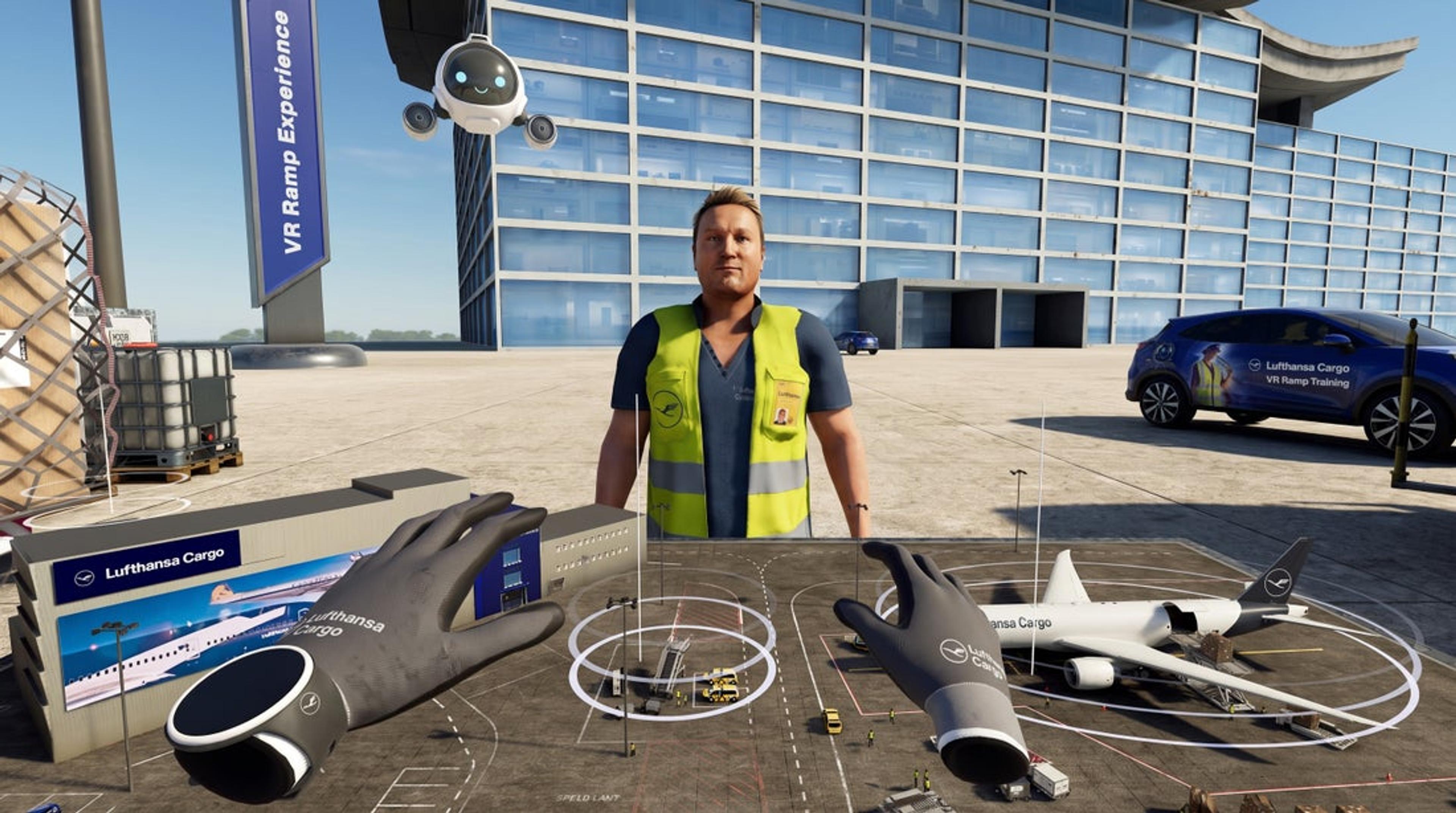
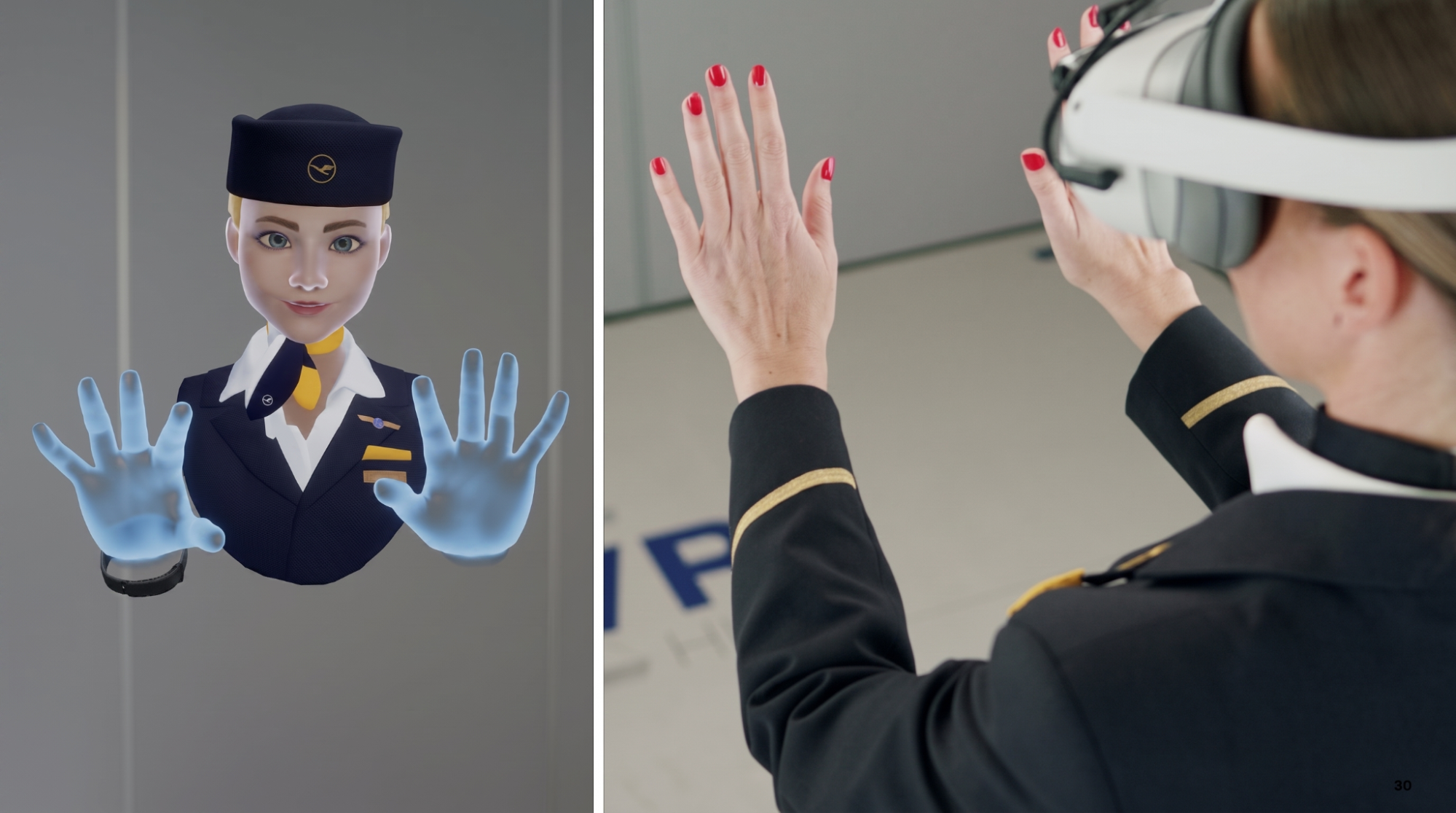
Controller-free hand movements from the Cargo Ramp Agent training course
According to NMY, XR training delivers five game-changing benefits that have resulted in Lufthansa largely replacing their older, analog-based courses that took place in physical mock-ups and aircraft:
- Realistic room-scale immersion:
- Natural, room-scale movement, and controller-free spatial interaction, bring the training closer to a real-life "holodeck" (as in the Holodeck room from the television series Star Trek) experience.
- Trainees step into a 1:1 digital twin of their work environment, creating a strong sense of physical presence.
- High learning effectiveness with deep focus and muscle memory: NMY’s own internal research and empirical client surveys demonstrate a 4x higher learning effectiveness compared to traditional classroom settings, manual reading, or 2D e-learning videos. The reasons for this include:
- Training sequences begin with visual cues and features that are gradually phased out, pushing learners to execute procedures in a realistic simulation relying on muscle memory. This can lead to higher knowledge retention and faster, more confident recall in critical real-world situations.
- Teams can safely experience and resolve virtual extreme hazards, fires, and critical equipment failures that are physically impossible or too dangerous to simulate on a real aircraft.
- Overall, immersive VR captures the learner's attention and eliminates external distractions.
- Major cost and time savings, including 80% reduction on trainer travel costs:
- For employees: They now only need to commute locally or regionally to their nearest XR hub, with a choice between Brussels, Frankfurt, Munich, and Zurich.
- For senior instructors: They previously had to fly from headquarters to Brussels or Zurich, book a hotel, and lose two days of productivity just to conduct a two-hour exam.
- Now, they work from HQ (e.g., Frankfurt) and use the NMY System Operator (via a tablet or desktop dashboard) to dial in remotely for training. They can see exactly what the trainee sees, evaluate the exam in real time, and trigger live stress scenarios (like smoke or technical errors) at the push of a button.
- The digital twin synergy: Once a highly complex aircraft is digitized, that same 3D asset is reused across the entire corporate group. Cabin crews use it for security and service drills, while cargo teams use it for ground logistics and technical handling. This "build once, deploy endlessly" philosophy maximizes asset ROI across the organization.
- High learner engagement: Grounded in NMY’s proprietary learning model, the interactive, gamified mechanics turn routine compliance into an engaging experience. Post-training surveys consistently show that learners prefer this intuitive, hands-on training.
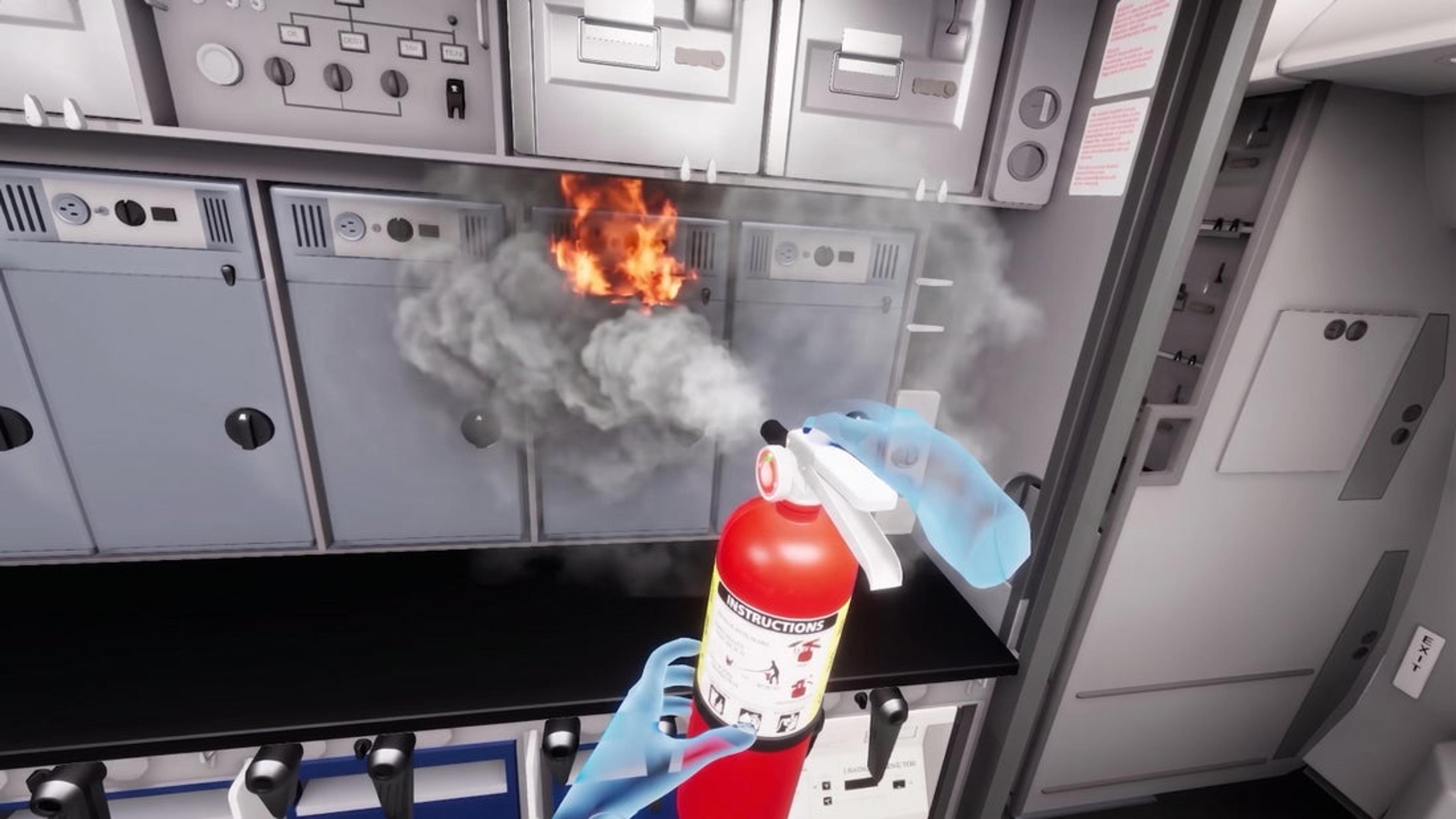
Safety-critical training scenarios, such as extinguishing a fire, are only possible in XR training.
“XR is the decisive technological lever to reduce real operational errors by up to 50%, delivering a resource-saving, sustainable training program that ensures excellent quality standards worldwide.”

Momo Ruzic - Lufthansa Group
Head of Aircraft Handling FRA , Lufthansa Cargo
Unity Industry: The technical foundation for aviation enterprise XR training
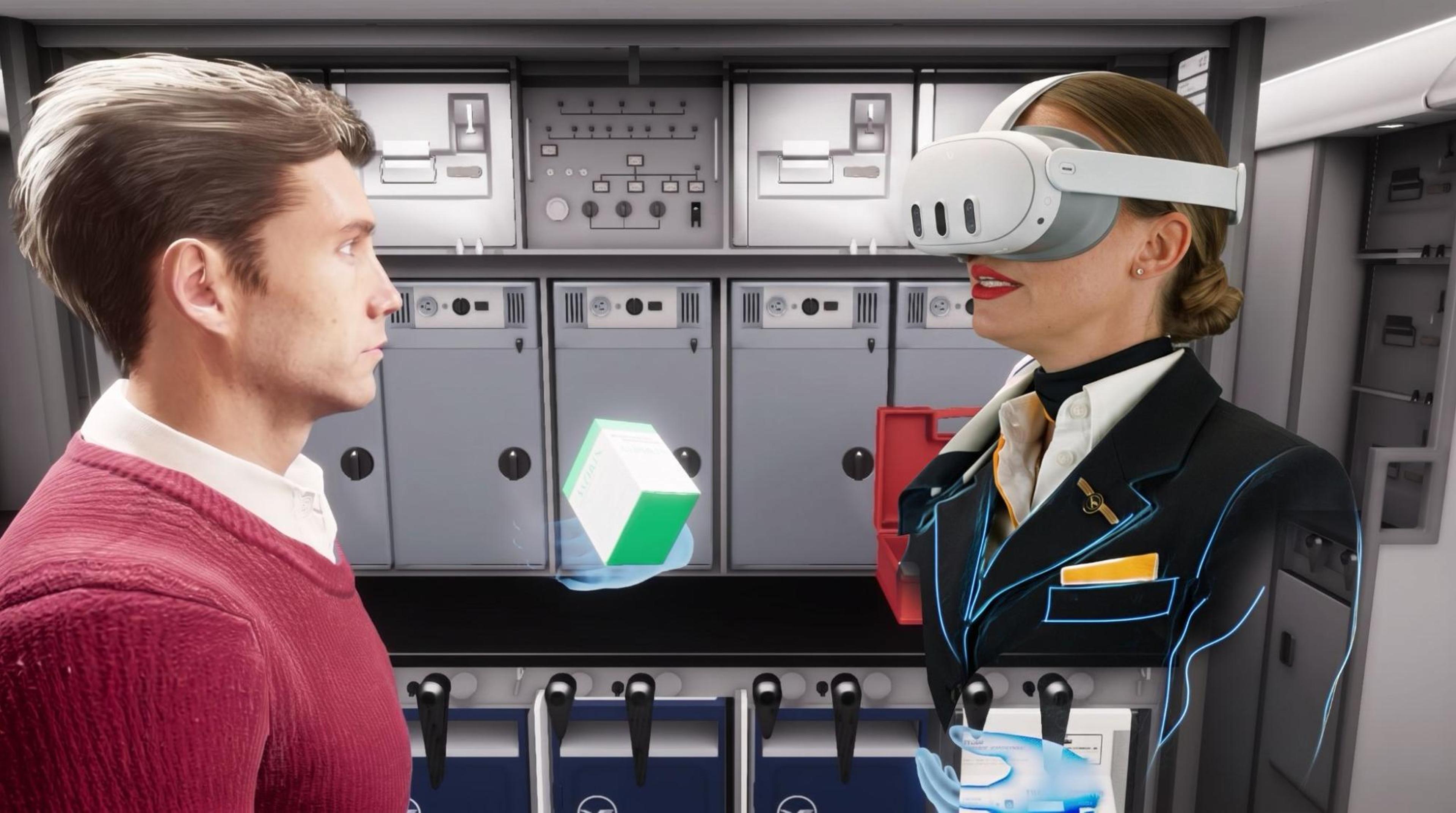
NMY’s Immersive virtual training has improved learning outcomes for Lufthansa’s employees (based on NMY’s own internal research and empirical client surveys).
Unity Industry is NMY’s core development platform, enabling them to handle the full mixed reality spectrum.
As Sebastian Demmerle, CEO of NMY, says, “(Unity Industry) acts as the primary engine driving our multiplatform software strategy. With Unity’s flexible architecture and tools, we can bring massive, highly complex 3D scenes (like an entire Boeing 777F or detailed cabin interiors) onto standalone, mobile VR devices as well as flat-screen devices, and scale and maintain these high-fidelity, safety-critical training applications for the Lufthansa Group.”
Unity’s “build once, deploy everywhere” pipeline allows NMY to remain hardware-agnostic and select the right device for a client’s specific operational, security, or logistical constraints. Their current target platforms are:
- Standalone and PCVR: High-immersion spatial applications deployed to mobile VR headsets as well as high-end, tethered PCVR setups.
- Mobile and desktop fallbacks: Seamlessly exporting the exact same 3D assets and logic to iOS/Android tablets (touch control), desktop applications (mouse/keyboard), and web browsers.
Building a globally certified, enterprise-scale XR ecosystem requires a structured and optimized production pipeline. NMY’s development team is made up of 15-20 professionals, with their main development process divided into the following stages.
1. Foundation, setup, and modular architecture
The process: Before importing heavy CAD data from aircraft manufacturers, NMY established a robust, modular project architecture. Because this ecosystem spans standalone VR, PCVR, tablets, and desktop applications, codebase reusability and clean dependency management are critical.
Their core technical team, comprising XR software engineers and Unity developers, writes the C# logic driving the training sequences and customer interaction mechanics. By deploying internal framework solutions and modular systems, their engineers deliver a stable, sustainable, and reliable foundation designed for long-term maintainability.
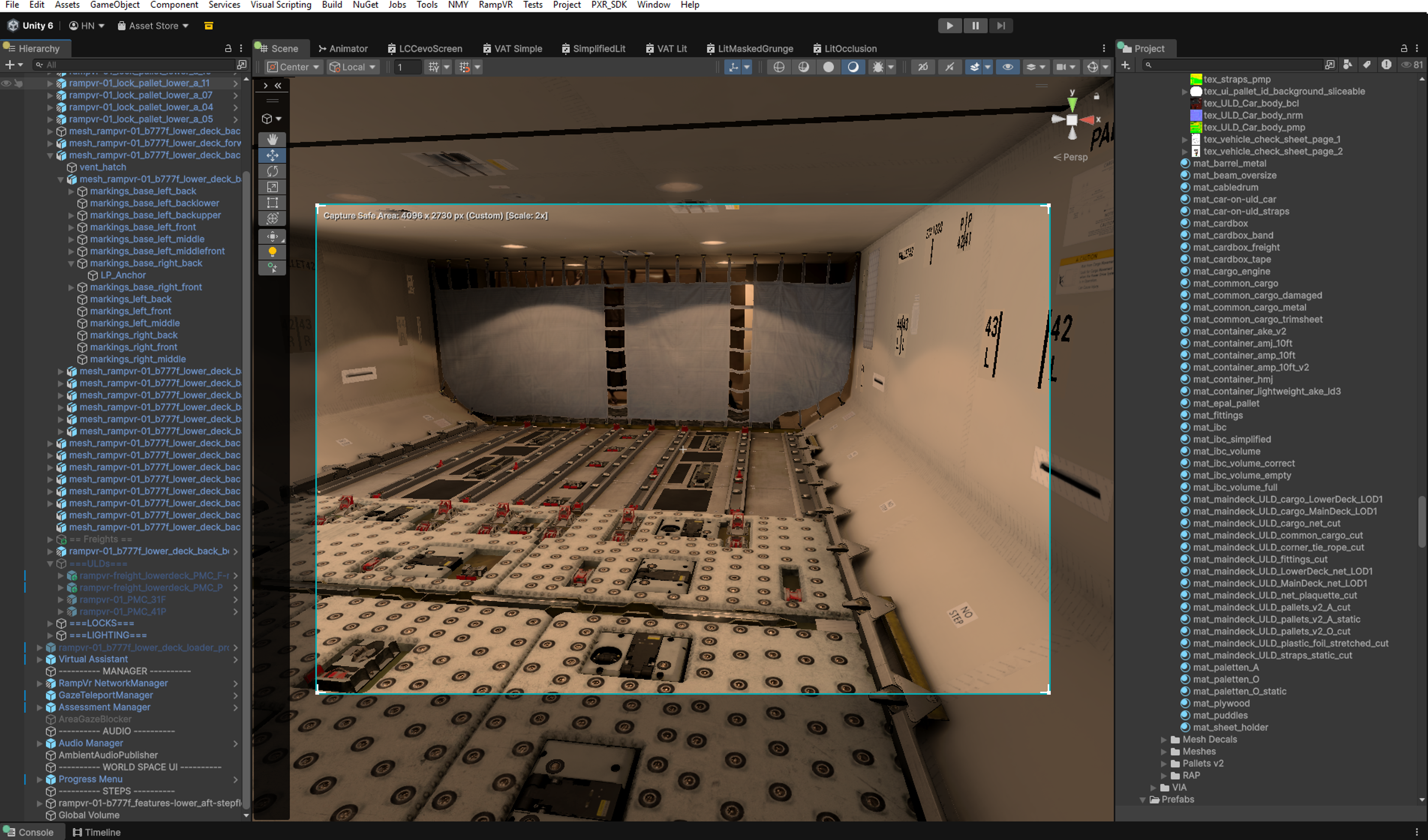
A model of the interior of an aircraft open in the Unity Editor
Main Unity Industry tools:
- Unity Package Manager (UPM): UPM allowed NMY to wrap their proprietary systems into version-controlled packages, making cross-project modularity, according to Sebastian Demmerle, “as easy as installing a plugin.”
- Unity ScriptableObject: ScriptableObjects are an essential component of the project architecture because they enable a loose coupling between the data layer and executable components in the scene.
- They make it easier for NMY’s developers to implement design patterns such as Model-View-Presenter even within the abstraction layer of a 3D engine. They also enable them to implement a wide field of asset-based approaches like event systems, types, or shareable variable storages, helping to keep the code clean and avoid static context.
"Unity’s modular and extensible architecture, paired with the powerful C# .NET framework, makes it a highly flexible toolset,” says Mark Peter, a team lead developer at NMY. “We can rapidly create MVP builds using high-level APIs. When tackling more complex challenges, we can leverage powerful low-level features like Addressables, DOTS (Data-Oriented Technology Stack), the Burst compiler, and the C# job system to deliver the required performance. Ultimately, this allows us to implement high-fidelity, cross-platform aviation training without compromising on realism, even on standalone VR."
More technical know-how from Unity
- Game programming patterns tutorials playlist
- Introduction to DOTS concepts, features, & samples for advanced Unity developers
- Create modular game architecture in Unity with ScriptableObjects
2. Asset production and technical art
The Process: NMY’s 3D and tech art teams optimize all of the assets to ensure 1:1 scale aircraft environments run at stutter-free frame rates on mobile VR GPUs. This stage also involves integrating realistic human avatars to serve as virtual trainers or passengers.
In addition to asset optimization, NMY’s technical artists configure shaders, bake lighting, and use the Universal Render Pipeline (URP) to maintain performant framerates. They also ensure that every virtual fire extinguisher, cabin door, and cargo high-loader moves and reacts with 1:1 physical accuracy.
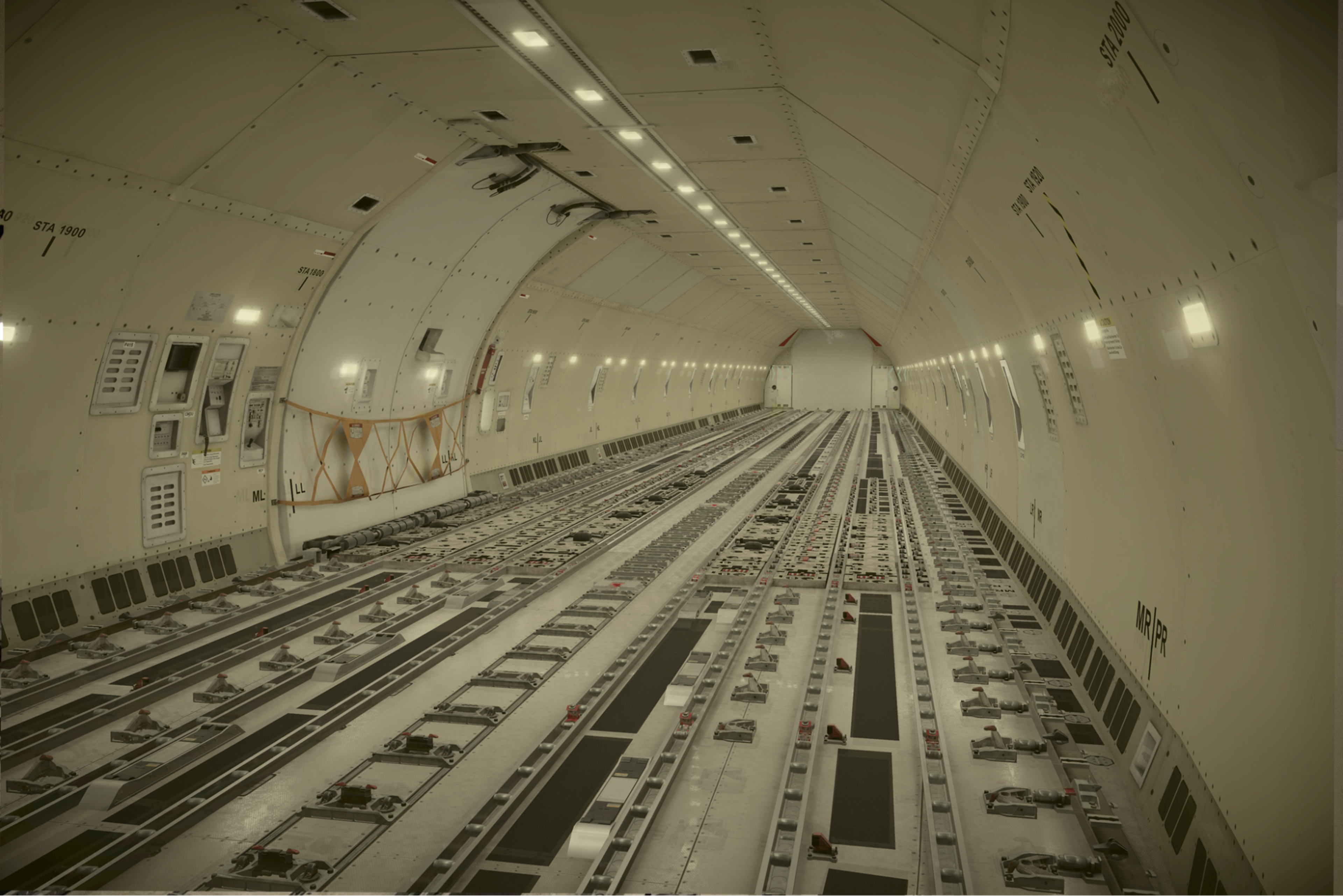
A highly detailed photorealistic model of an aircraft interior
Main Unity Industry tools:
- Universal Render Pipeline (URP): URP provides workflows that let artists and technical artists efficiently create optimized graphics across a range of platforms, from mobile to high-end consoles and PCs.
- Compute Lightmap Baker and xAtlas: These are crucial for their environment optimization. They bake high-fidelity lighting into the static scenes and handle texture atlasing, keeping memory usage low while maintaining photorealism.
- Shader Graph: Their technical artists can visually script dynamic, custom materials (such as interactive glass, smoke, or highlighting hazard states) without heavy code overhead.
- Pipeline I/O support: They use I/O pipelines to connect external character animation software directly to Unity, including the Rokoko motion suit, Character Creator (CC5), and iClone to create lifelike movement for the digital avatars.
“If a specific tool doesn't exist, Unity's open architecture allows us to develop it ourselves and scale it across other enterprise projects,” says Sebastian Demmerle.
More technical know-how from Unity
- Create popular shaders and visual effects with the Universal Render Pipeline
- Introduction to URP for advanced creators
3. Interaction design and core XR development
The Process: In this stage, software engineers build the core training logic. The primary goal is to eliminate technology anxiety for the end-user by ensuring natural, intuitive interactions with the virtual environment across all supported platforms.
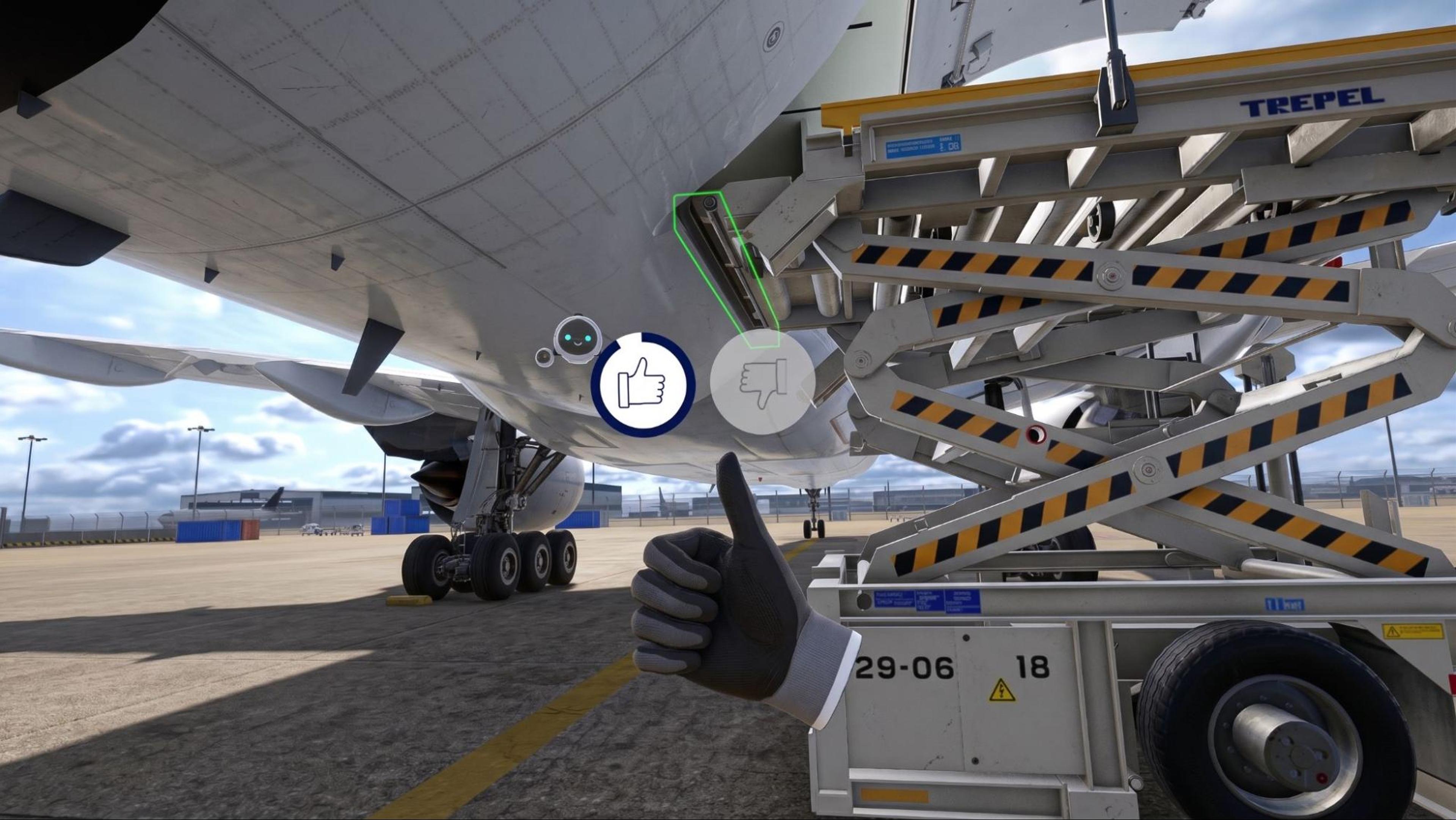
Inside the Cargo Ramp Agent vocational training application
Main Unity Industry tools:
- XR Interaction Toolkit and XR Hands: These packages form the backbone of their training framework. NMY implemented custom, training-specific interactions, and natural hand interactions so flight crews and ramp agents can operate virtual tools, open doors, flip switches, and grab fire extinguishers without clunky controllers.
- Unity built-in 3D physics: NMY leveraged Unity's built-in 3D physics engine and the High Definition Render Pipeline to replicate realistic cabin interiors, cargo holds, and heavy equipment down to 1:1 scale.
More technical know-how from Unity
4. User interface (UI) and global content localization
The Process: UI and interaction designers implement the spatial interfaces and user flows by using Unity’s UI Toolkit. They work with both spatial menus for VR headsets and scalable 2D touch interfaces for the iPad and desktop fallback versions.
Additionally, the training modules must support Lufthansa’s international workforce with instructional text and voiceover available in multiple languages.
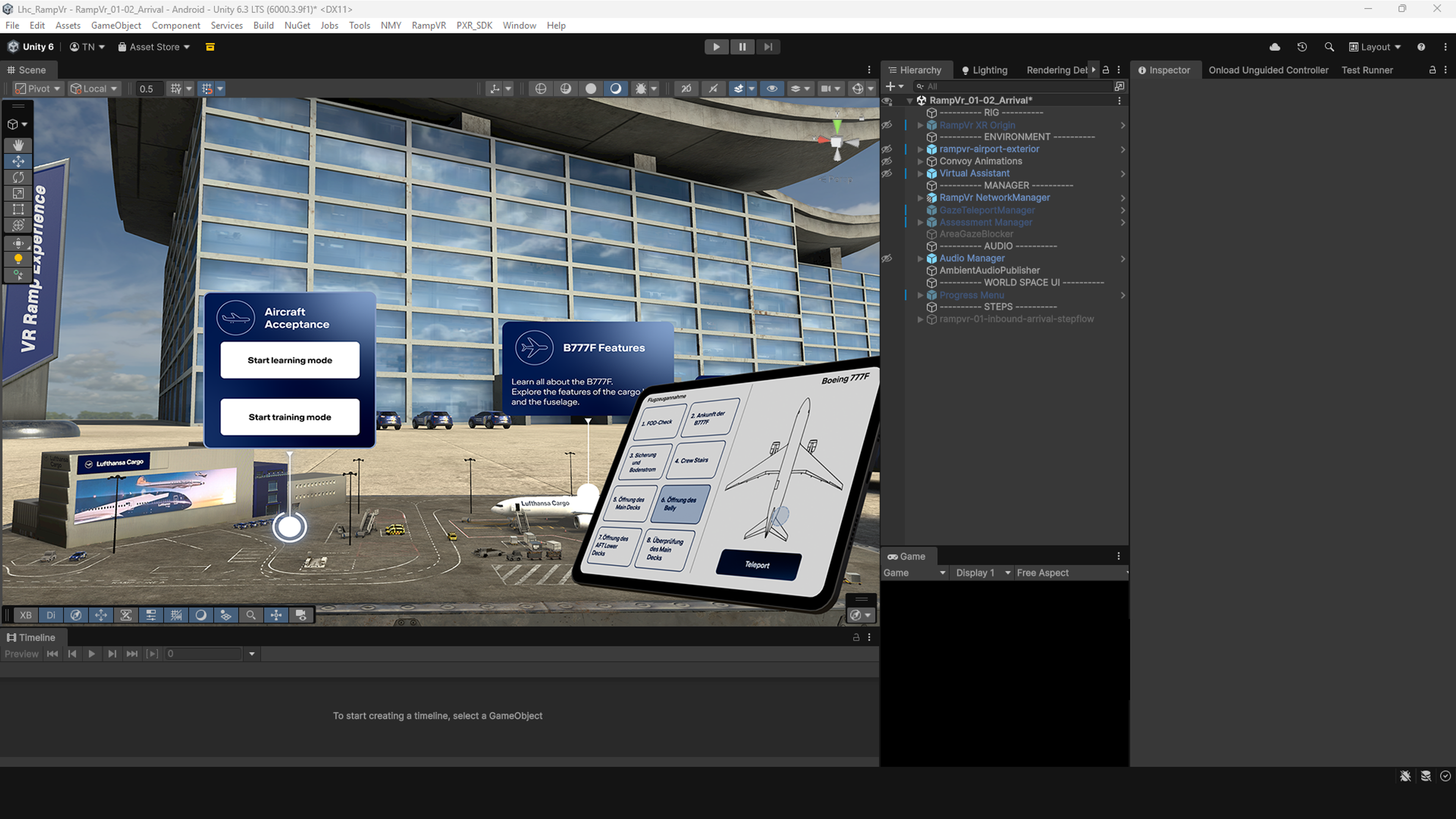
Examples of UI elements from the training applications
Main Unity Industry tools:
UI Toolkit: UI Toolkit is inspired by standard web technologies, enabling teams to separate the structure, style, and behavior of UI, similar to how you might with HTML, CSS, and JavaScript. For NMY, it allows its designers to efficiently adapt one base UI design to fit different clients, screen sizes, and device types.
Unity Localization package: This package is integrated directly with external content providers like Google Sheets. It allows subject matter experts and clients to comfortably author, translate, and review multilingual text assets without needing to touch the engine build.
More technical know-how from Unity
5. Performance optimization and content delivery
The Process: The final build stage focuses on long-term scalability. Instead of forcing clients to download a massive application update every time a new aircraft or training scenario is added, NMY decouples the heavy content from the core application shell for seamless deployment to the XR hub.
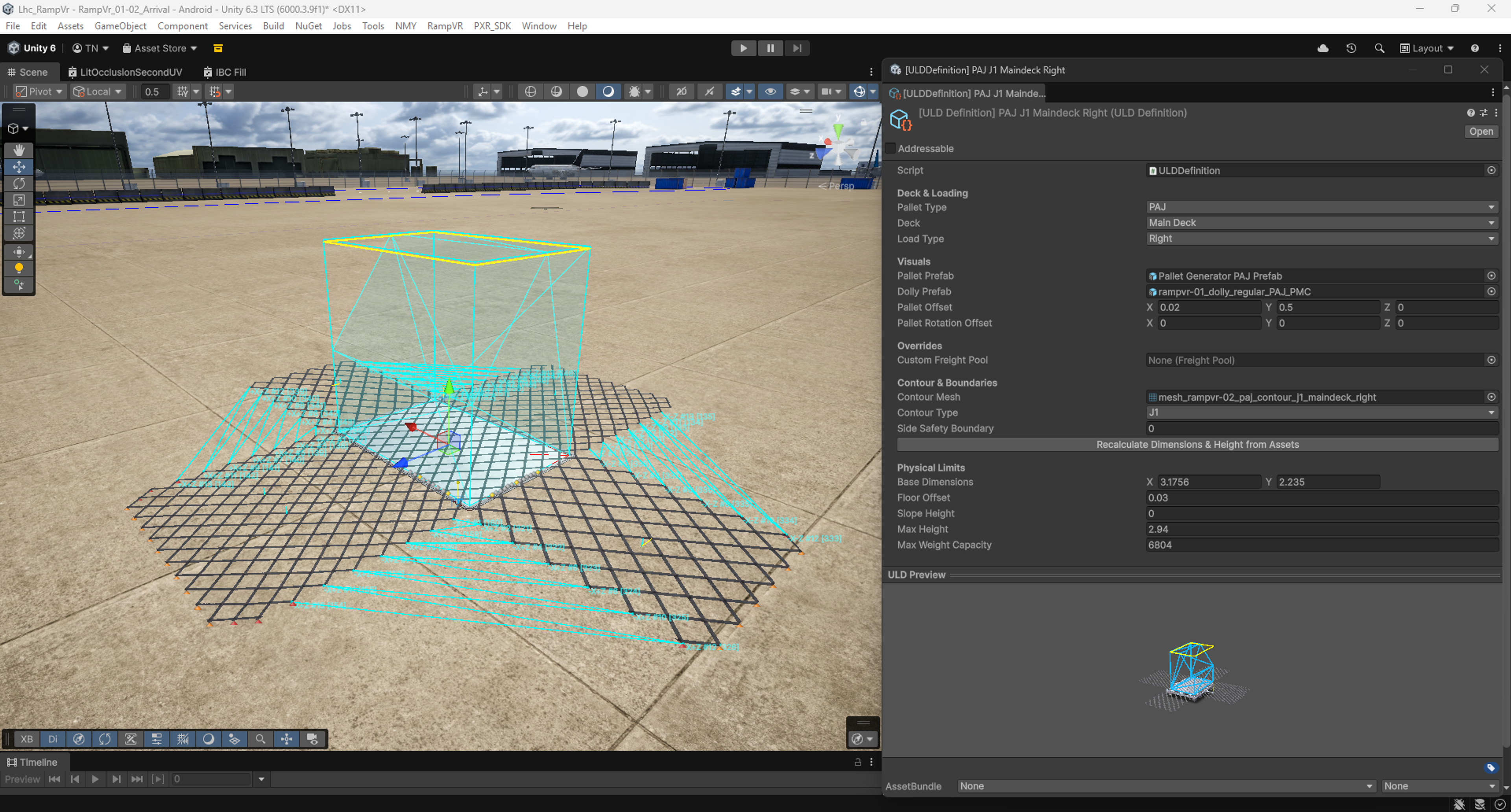
Using Addressables for detail-heavy objects
Main Unity Industry tools:
Unity Addressables package: Sebastian Demmerle refers to the Addressables package as his team’s "silver bullet" for memory management. Instead of forcing a mobile VR headset to allocate an entire aircraft at once, the Addressables package allows NMY to stream heavily detailed modules in and out of memory at runtime. This keeps the GPU memory usage and performance optimal.
The Unity Profiler: NMY’s quality assurance engineers rely on the Unity Profiler and other in-engine debugging tools to test cross-platform builds, monitor memory usage to prevent hardware crashes, and validate that the automated examination scoring logic triggers correctly under virtual stress conditions like fire hazards, smoke, or complex cargo loading operations.
More technical know-how from Unity
- Optimize your game performance for mobile, XR, and the web in Unity
- Ultimate guide to profiling Unity games
6. Scalable enterprise and systems integration
The process: Unity acts as the central hub connecting NMY’s interactive client software with back-end enterprise architecture.
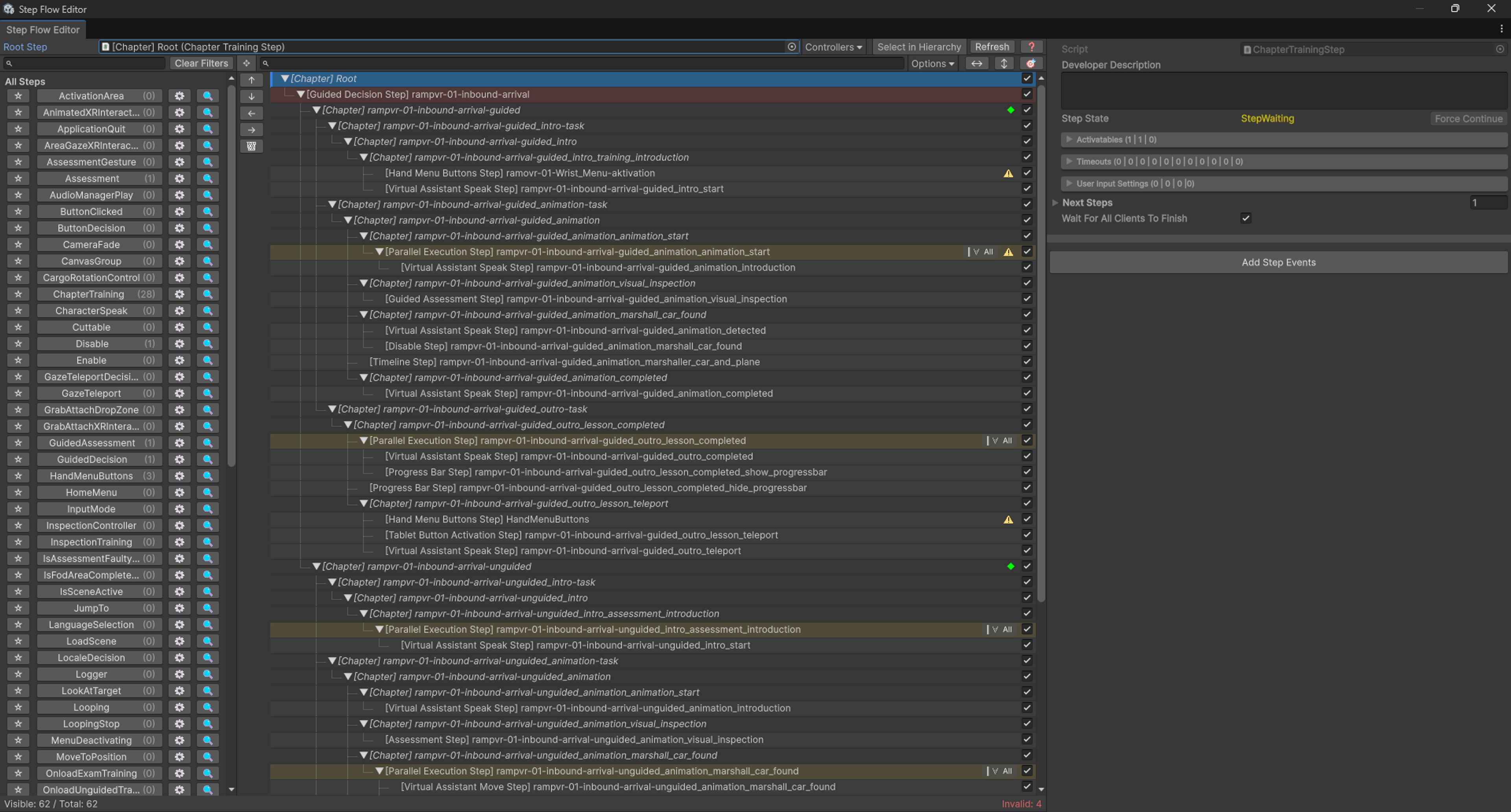
The many steps from one of the training applications, in the Editor
Main Unity Industry tools:
- Unity’s extensibility and integration capabilities: NMY can link Unity client applications to their proprietary NMY System Operator dashboard, allowing instructors to monitor live video feeds, inject real-time stress hazards (like smoke or system failures), and evaluate trainees remotely. This foundational capability has enabled Lufthansa to cut trainer travel costs by 80%.
- Custom APIs: By integrating custom APIs into Unity, NMY’s applications can communicate pass or fail exam data directly to Lufthansa’s learning management system (LMS) and HR databases without manual intervention.
NMY’s XR training ecosystem is just the beginning
“We’re not at the finish line,” says Sebastian Demmerle. “Our XR training foundation will be the operating system for a much larger enterprise ecosystem. Our focus is on transforming this platform from a pure training tool into an intelligent, interconnected spatial computing environment.”
Sebastian and his team outlined their next steps for their XR ecosystem and how Unity will help them get there:
Scaling the ecosystem
The immediate next step is rapid horizontal scaling. They’re expanding beyond cabin security and cargo handling to include complex Maintenance, Repair, and Overhaul (MRO) procedures, pilot familiarization, and full-fleet rollouts (scaling from one aircraft type to the entire Lufthansa fleet).
How Unity Industry helps: They’ll continue to rely on the Addressables package and Unity Package Manager. They can author the new 3D assets and logic, and stream them as modular DLC content to the existing application hubs, ensuring efficient scalability without bloating the core app.
Incorporating AI solutions and dynamic scenarios
They’ll move from scripted training scenarios to highly dynamic, unpredictable AI-driven environments. They aim to implement smart NPCs (non-player characters) for realistic roleplay, such as de-escalating unruly passengers, interacting with air traffic control, or dealing with dynamically generated hazard cascades that adapt to the user's skill level.
How Unity Industry helps: “Unity Sentis is going to be a game-changer for us here,” says Sebastian Demmerle. “Sentis allows us to run advanced neural network AI models locally, directly within the Unity runtime on the VR headset. This means we can deliver AI-driven voice commands, real-time translation, and smart avatars with zero cloud latency and absolute data privacy, which is a strict requirement for enterprise aviation security.”
Robotics and automation
The aviation industry is moving quickly toward apron automation. NMY want to expand their digital twins to include autonomous luggage tugs, robotic ground handling equipment, and teleoperation. The goal is to use the exact same XR environment not just to train humans, but to simulate, train, and monitor real-world robotic systems.
How Unity Industry helps: Unity Robotics capabilities will enable NMY to bridge real-world robotic sensors with their virtual 3D environment. They’ll be able to simulate LiDAR or camera data in Unity to train machine learning models for the robots, or stream real-time telemetry from physical apron robots into a VR digital twin, allowing human operators to monitor or teleoperate machinery remotely.
CTA: Learn more about Unity Simulation Pro early access
Advanced wearables, haptics, and biometrics
NMY aims to integrate “advanced wearables” into the XR experience, including haptic feedback gloves and suits to simulate the physical resistance of heavy machinery or fire. They also want to use eye-tracking and biometric sensors to measure a trainee’s cognitive load and stress levels during an exam. And they hope to target lightweight AR smart glasses for on-the-job maintenance support.
How Unity Industry helps: Unity’s XR Plug-in Management, OpenXR, and XR Interaction Toolkit packages will provide a standardized bridge for incorporating the advanced wearables without having to rewrite core application logic.
“Unity has been our trusted companion since day one,” says Sebastian Demmerle. We look forward to seeing how NMY continues to innovate in the future and push the tech and graphics capabilities of Unity Industry.
Watch the video to learn more.