ART S.p.A. turns cockpit design opinions into data with Unity and VR

Customer
ART S.p.A. (Advance Research Technology), Passignano sul Trasimeno, Italy
Industry
Automotive, Tier 1 supplier
Solution
Cockpit Design Suite, a VR-based design review and prototyping platform for cockpit UX and HMI
Unity products used
ART S.p.A. builds cockpits for some of the fastest cars in the world. Its new tool, Cockpit Design Suite, takes the discussion that often occurs between design teams and HMI teams, and settles it with data. It runs on Unity, and it will be released in October 2026.
A Formula 1 data company that ended up inside the car
ART S.p.A. was founded in the early 2000s and is one of Italy's leading providers of connected infotainment systems, digital cockpits and advanced HMI solutions for the automotive and mobility industries. ART S.p.A innovates and produces high-tech systems, providing customised and unique solutions. The fast-growing company now has approximately 300 employees at its headquarters in Passignano sul Trasimeno and offices located in Modena, Turin and Berlin, Germany. ART S.p.A represents a Made in Italy excellence capable of competing with large multinational groups active in the sector.
ART S.p.A's portfolio includes a wide range of infotainment, instrument clusters, and onboard electronics programs. Examples include the infotainment developed for the Pagani Utopia, a car with no touchscreen at all, where a single driver-facing display carries navigation, comfort, safety, and entertainment, and its ClusterX digital instrument cluster, which debuted on the Alfa Romeo 33 Stradale. In 2025, ART S.p.A began a collaboration with Ducati for the design, production, and supply of onboard electronics, with a strong focus on enhancing the rider experience through seamlessly integrated technology.
The problem nobody in the industry had solved
ART S.p.A sees the same pattern on program after program. Style comes first. A design team defines the look, the colors, and the topology of the cockpit. Only then does the HMI team start work. And then the two teams have to agree.
"Two different players are working together, the style team and the HMI team, and usually they clash," says Federico Doricchi, Head of Product Organisation.
"They don't have a structured process or tools to generate objective data to make decisions on," he says. "So it is, I feel that this is the right solution, and on the other side, I feel the other one is the solution. But there is no data you can decide on."
What follows is a compromise that often satisfies neither team. The answer arrives much later, when the first physical prototypes are built and tested. That is when someone discovers that the beautiful control panel is a problem the moment you have to reach for it while driving.
By then, the change is expensive. The OEM raises change requests, pays for rework, and risks delaying the start of production. The Tier 1 gets paid for the extra work, but absorbs the disruption. Engineers who expected a predictable plan face a lack of clarity.
The alternative is to test earlier, which means physical mockups involving machined parts, wiring, software builds, and weeks of lead time for every variant a team wants to compare. Additionally, a physical mockup will provide you with opinions, not measurements.
"Time, cost, and approximate data," says Doricchi. "Not precise, well-structured data."
Cockpit Design Suite: a design review you can measure
Cockpit Design Suite, built by ART S.p.A. with Unity Industry, is a VR design review platform that lets OEM style and HMI teams test cockpit layouts against measured user data. It is a rapid prototyping and simulation platform that moves cockpit design review into virtual reality, built to enable the difficult decisions to be made earlier on in the process - based on data, not opinions.

Cockpit Design Suite has three parts:
The scene, authored in Unity.
A designer builds the environment in the Unity Editor, with ART S.p.A.'s plugin installed. That covers the world the vehicle sits in, and the vehicle interior itself, down to the placement of individual controls. Should the adaptive cruise control switch live on the steering wheel or on the transmission tunnel? Both versions get built as variants in the same project.
The session is run in VR.
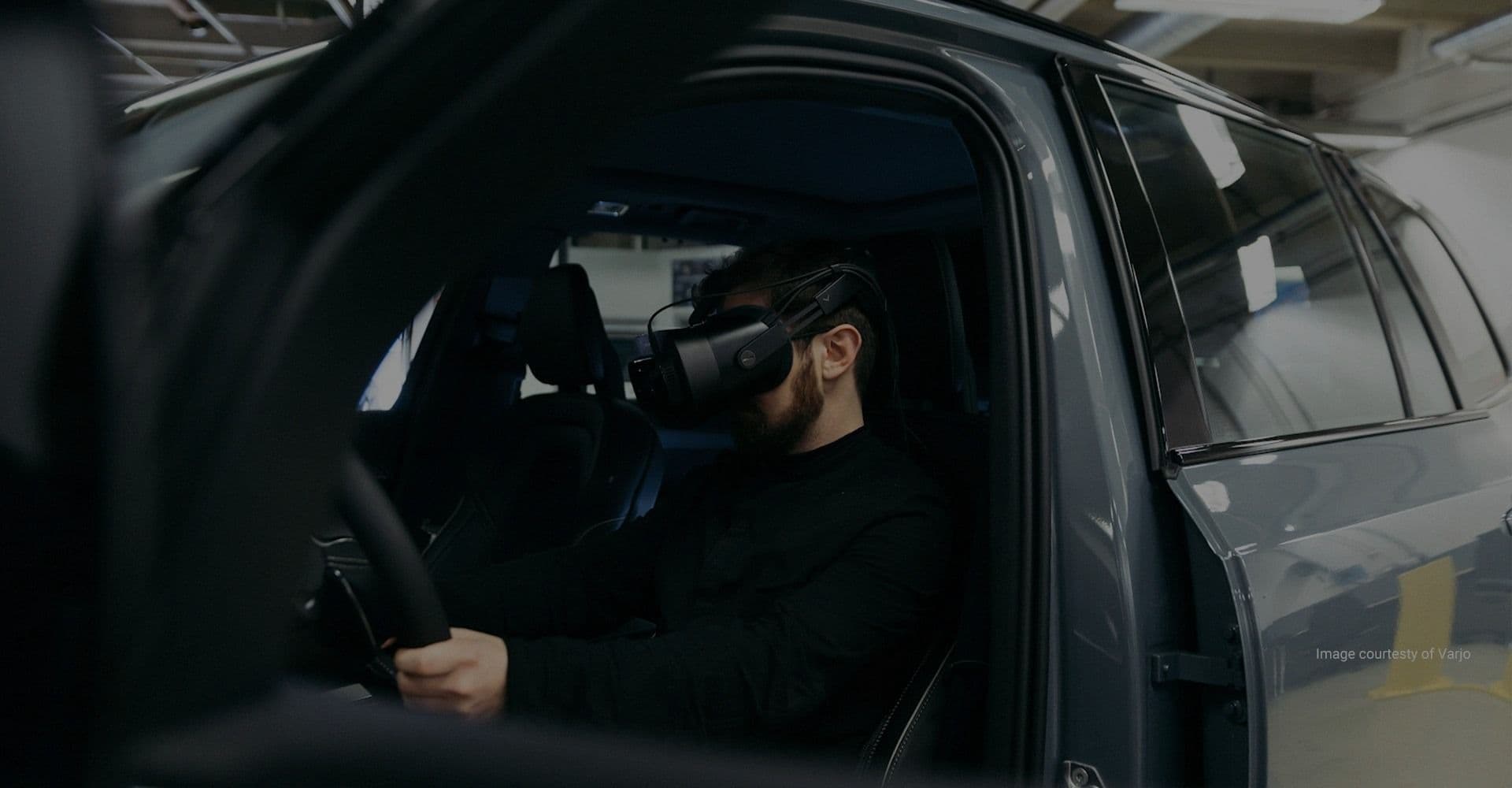
A tester puts on a headset and experiences the cockpit at full scale. Cockpit Design Suite supports hand and gaze tracking, so a tester can turn the wheel and reach for a control without a controller in the way. The system records where people look, what they reach for, and how they move.
The analysis is delivered through a portal.
Every session feeds a connected dashboard where teams arrange charts and figures, compare variants, and see which layout actually performed against the experience they intended.
Cockpit Design Suite analytics dashboards

Example 1: Configuration Variant table

Example 2: Quiz Result Chart
The plugin ties it together by giving designers a way to structure a project so every variant, every user, and every session comes back as clean, comparable data rather than a folder of impressions.
That structure is the part ART S.p.A believes nobody else has built.
"We made the benchmark," says Doricchi. "Some companies make only tools to help OEMs design cars. The gap we saw was on one major topic, data collection. The definition of the use cases, the measurement of user behavior, and the collection and analysis of that data through a dedicated portal. That was totally missing."
Cockpit Design Suite is not limited to cars. The same workflow can be applied to motorcycles and trucks, and ART S.p.A is integrating wearables - such as heart-rate chest straps - into the platform.
Inside the Unity build
Stefano Zingarini, Technical Lead and Platform Manager for Cockpit Design Suite, splits the Unity work into two blocks:
The first is photorealism. Because testers are wearing a headset and moving their heads freely, lighting and reflections are not decoration, they are intrinsic to effective assessment of the design.
"The shadows are very important for our product," says Stefano. "You can see whether the sunlight is going to reflect or make things blurry."
ART S.p.A.'s team includes Unity photorealism specialists who tune materials, lights, shadows, and environment lighting to get a cabin that behaves like the real one.
The second block is the plugin, written in C#, which connects events raised by the photorealistic scene to the business logic ART S.p.A needs for a design review. Move the indicator stalk down, and the plugin fires the event that switches the material and turns on the left turn signal.
Underneath, the plugin hooks into Unity's XR APIs to capture the raw interaction data. Head movement, gaze, and hand tracking all flow through the same pipeline that feeds the analytics dashboard. Testers can operate the cockpit with their hands alone, with no controllers involved.
"The added value of the product is the analytics of the data recorded while testing a solution in its multiple variants and use cases as well as the scenario simulation," says Zingarini.
ART S.p.A can also run the whole build as a service, which puts the team close to early adopters and their feedback. The OEM supplies the high-fidelity 3D model, ART S.p.A constructs the scene, and the customer handles the analysis. Over time ART S.p.A expects some customers to bring the authoring in house, and several prospects have already expressed an interest in building Unity skills of their own.
Because a program's 3D data changes constantly, and because different departments need different levels of detail, ART S.p.A is considering Unity's asset tooling solutions to manage model versions and polygon reduction across the workflow.
Why Unity
The first reason for ART S.p.A choosing Unity is reach. "The first reason is how good the product is, and how widespread it is around the world," says Federico. "Not only for automotive applications, but in general as a consumer solution."
For a Tier 1 planning to sell a tool to OEMs, that matters because it means there is a large talent pool to hire from. Further, customers who want to take the work in house can find people who already know the Unity Engine.
The second is the working relationship. "We’ve built a good relationship and trust between the people and the companies," says Doricchi. "But without the technology that fulfilled our need, it would not have been possible."
Zingarini adds a third, from the engineering side. Unity, he says, is a good bridge between automotive user interface work and automotive design work. Two disciplines that normally use different tools can now share one environment.
Why VR, and not mixed reality
ART S.p.A made a deliberate call to build on full virtual reality rather than mixed reality. The latter keeps a physical steering wheel and physical controls in the loop, which seems better for realism. However… "If you have mixed reality, then you still need the physical mockup," says Doricchi.
Arguably, dynamic driving simulation is weaker in VR, because a tester holding nothing in mid-air is not under real driving load. But Doricchi argues that mixed reality does not solve that either.
"How can you measure distraction?" he says. "The typical test is, set the navigation, turn on the climate, drive at 130 kilometers per hour, and overtake the car ahead. In mixed reality you have a steering wheel in your hands, but you still do not care if you do something wrong, because nothing will happen. So why spend money on mixed reality, which is more expensive and takes more time?"

Cockpit Design Suite rendered environment
What Cockpit Design Suite promises OEMs
Cockpit Design Suite will be released in October 2026, with about two months of stabilization to follow. No customer has run a full program on it yet, although the product has already generated interest among multiple organizations and talks are ongoing with many interested companies. Although there are no adopter numbers to report yet, ART S.p.A has a clear understanding on what the market wants from the tool.
The company has moved from pitching the concept to demonstrating the product, and the feedback from prospects has been consistently positive. It has also been revealingly inconsistent about why.
"Every one of them named a different killer feature," says Doricchi. "One said, if you really achieve photorealism, to us that is a killer application. Another said, use case definition and data collection, if you really manage to do that, that is the killer application."
"The key message to the car makers is you will shorten the time, you will not waste money on materials and software, and you will collect data on the use cases you already run, so you can measure user behavior and compare it," says Doricchi.
He guards against one misreading in particular. Cockpit Design Suite is not a way to build a 3D model faster. A team reaches roughly 80 percent of the environment quickly. The last 20 percent depends on how many decisions the OEM has to make, and how fast it makes them.
"It is more accurate to say, this is a tool that enables faster, objective decision-making," he says.
Looking ahead
ART S.p.A is already investing in a 2027 roadmap for Cockpit Design Suite. The bigger ambition sits outside the vehicle - adapting the workflow to any situation where a team has to choose between designs and would rather have hard data than opinions. For example, a factory floor - you are laying out a production line, and the people who will actually work on it have a view worth hearing. Put both layouts in VR, let the workers move through each one, and measure what happens.
"The real potential of this tool is that you can apply it to any case where you need to design something and collect data about how people interact and behave with that design," he says.
Unity's Industry Summit in Munich on October 7 will be an early public outing for the feature-complete build of Cockpit Design Suite, check back soon for an event recap!