From LiDAR scan to drivable circuit: The Unity pipeline behind the F1 Academy simulator

Why a simulator maker stopped building its own renderer
A driving simulator works only if the visuals match what the driver's brain expects. The image tells a driver speed, track surface, and position. Get it wrong and the car stops feeling like a car.
Cruden is an Amsterdam-based company producing high-fidelity simulators and driver-in-the-loop simulation software for automotive, motorsport, maritime, and defense customers. Its Panthera framework ties physics, motion, visuals, and audio together. Cruden chose Unity for their rendering technology, enabling them to focus on system integration.
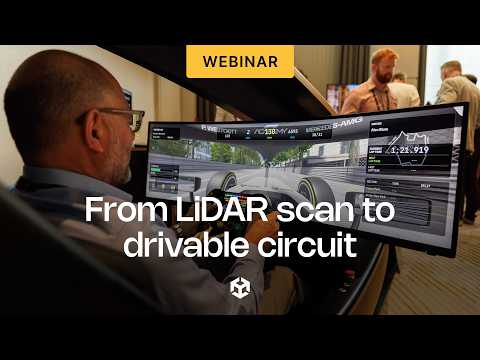
The Mercedes-AMG F1 Academy Simulator shows the results. It runs on Panthera and Unity's High Definition Render Pipeline (HDRP).
Cruden's motorsport track builds start with a LiDAR point cloud of the circuit. The scan is both the road surface the vehicle model drives on and the reference for the visuals. A custom Unity shader merges LiDAR intensity data with standard asphalt materials to put real surface detail on the road. HDRP and physically based rendering (PBR) handle the lighting.
In this on-demand webinar, Cruden CEO Maarten van Donselaar and Unity Staff Solutions Architect Simon Nagel walk through that pipeline, from scan data to a lit, race-ready environment. Watch the session to see how the team builds production-grade real-time 3D without maintaining its own engine, and how Unity Industry fits that workflow.
Key takeaways
Watch the webinar to learn:
- Why Cruden chose Unity as its render engine.
- How a LiDAR scan becomes both the road surface for the vehicle model and the reference for the visuals, and how a custom shader adds real surface detail.
- How the Cruden team uses baked HDRP lighting to hold 180 and 240 fps, with about 800 light sources and 12,000 light probes in a single night scene.
- The way to keep content and application separate so you, or your customers, can change tracks, vehicles, and layouts in the Unity Editor.
- Why visuals and physics need millisecond timing coherence.
- Where simulation fits across automotive, motorsport, maritime, and defense.
Webinar description and summary
Why Cruden chose Unity over its own render engine
Cruden focuses on dynamics, 3D visualization, motion, and system integration. Maarten explains why maintaining its own render engine was hard for a small team, and why that effort belongs in system integration. He covers what Unity offers in its place: easy prototyping in C#, a strong Editor that Cruden extends with its own tools, and experienced Unity developers and artists who are relatively easy to find.
He also shows how Panthera turns a game engine into simulator visuals. The setup renders across multiple machines for projection or direct-view LED displays, uses warp and blend with automated calibration, and lets an external physics engine such as Simulink run the vehicle model. Maarten then walks through what Cruden builds with Unity: driver-in-the-loop simulators for automotive handling; motorsport driver training and setup work on LiDAR-scanned tracks; maritime and defense training for fast craft and military vehicles; and simulators for attractions and events.
From LiDAR scan to race track
The scan is both the road surface the vehicle model drives on and the reference for the visuals. A custom Unity shader merges LiDAR intensity data with standard asphalt materials, so real surface detail shows up on the road.
Lighting is baked and physically based in HDRP. Static lighting supports 180 and 240 fps, with about 800 light sources in a single night scene and about 12,000 light probes lighting the car and other dynamic objects. HDRP also handles rain, wet asphalt, night races, and exposure.
Content and build stay separate, so Cruden updates a track without a new application. Last-minute changes happen directly in the Editor, and custom inspector windows cover grid positions, timelines, and road surface properties. Customers make these updates themselves, including their own vehicles, environments, and layouts.
Inside the Mercedes-AMG F1 Academy Simulator
Mercedes-AMG and Unity created the experience for the 2026 F1 Academy season. Cruden built the simulator software in Unity. The centerpiece is one track that laps four cities, built entirely in Unity. Each city has its own materials, lighting, and time of day, and HDRP holds up on the large displays around the cockpit.
Maarten shows how the simulator uses Cruden's modular Panthera framework. A core box handles the vehicle model and physics, timing and synchronization, and session logic. Around it sit the Unity renderer, FMOD audio driven by the vehicle model, a custom steering wheel and pedals, and the HUD and leaderboard. The physics approach matches Cruden's Formula 1 driver-in-the-loop simulators, and visuals and physics hold millisecond timing coherence.
The team handled light baking for a large environment and the integration of a custom steering wheel and pedals. Cruden turned an existing track, built outside Unity, into a Unity environment with full lighting and exposure on a very quick turnaround.
Why simulation pays beyond the race track
Visual fidelity works as a motion cue. Simulation pays wherever real-world repetition is expensive, risky, or hard to arrange. Maarten covers the outcomes to expect: faster driver training, faster engineering, safe and repeatable practice under identical conditions, fan engagement at events, and savings on people, money, and the environment.
Lessons learned and what's next
Maarten closes with three lessons. Focus on your core and let the engine do the rendering. Keep installation, operation, and maintenance simple and upgradable. Keep customer-specific development separate from the core, in the Panthera SDK.
He then looks at what's next in Unity for Cruden:
- Moving Panthera rendering to Unity 6, with the GPU Resident Drawer for larger environments at high frame rates.
- Adaptive Probe Volumes for dynamic time of day on baked tracks.
- Faster light baking for shorter track turnaround.
Maarten and Simon close with audience questions.
Watch the webinar
Fill out this form to access the webinar


