From LiDAR to lap times: building a driving simulator from scan data in Unity
A professional driving simulator lives or dies on one thing: whether what the driver sees matches what their brain expects. Get the visuals and the physics right in the same frame and a simulator becomes a usable substitute for track time. Simulator builders often use Unity’s High Definition Render Pipeline (HDRP) and physically based rendering (PBR) to turn raw LiDAR scan data into a circuit a driver recognizes instantly. A similar pipeline powers the Mercedes-AMG F1 Academy Simulator appearing at events including the British Grand Prix and the Las Vegas Grand Prix.
That simulator is a joint experience created by Mercedes-AMG and Unity for the 2026 F1 Academy season. Mercedes-AMG and Unity shaped the experience together. Netherlands-based simulation pioneer Cruden built the simulator software using Unity technology.
“A simulator is great for track learning and just driving in general. Staying on your toes. This is how a lot of drivers train, because we can’t be at the track every single day. Nothing’s better than real life, but this is pretty close.”

Payton Westcott - Mercedes-AMG F1 Academy
Driver

Visual fidelity is a motion cue, not a finish
In a professional simulator, the picture is not decoration. It is a motion cue. The visual environment is what lets a driver’s brain interpret speed, track surface, and spatial position. Those readings shape the physical realism of the run and how emotionally engaged the driver is. When the image lags or the surface reads wrong, the driver feels disconnected from the car.
That sets a hard requirement. The renderer has to be near-photorealistic and real-time performant at once, neither one on its own is enough.
Four problems every simulator pipeline has to solve
- Photorealism at real-time frame rates. Rendering has to look production-grade while running fast enough to hold immersion and motion accuracy. One of those without the other breaks the simulation.
- Rendering nobody wants to build in-house. PBR is the industry standard. Building and maintaining a custom rendering engine to match it is not realistic for most organizations.
- Content creation the customer can do. Engineering customers want to build and modify their own vehicles, environments, and track layouts. Complex tooling becomes a barrier to entry.
- Visuals and physics locked together. A photorealistic environment counts for nothing if the car does not behave like the car. What the driver sees and what the driver feels have to agree.
How the Unity pipeline handles each challenge
Production-grade rendering without the engine overhead. HDRP and Unity’s PBR materials deliver industry-standard visual fidelity with no custom engine to build or support. HDRP also produces realistic ambient lighting derived from ray tracing but pre-processed, so it does not consume the GPU budget that runtime ray tracing does.
From point cloud to recognizable circuit. Motorsport track builds typically start with LiDAR scan data supplied by the customer. Teams work with that point cloud directly in Unity, then layer in the granular detail that makes a circuit legible: asphalt texture, brake markers, curbs, and skid marks a driver recognizes from the real lap.
Sub-millisecond coherence between systems. Precise vehicle dynamics and tire model data translate directly into the simulation. Sub-millisecond timing coherence between the motion, visual, and physics systems removes any disconnect between a driver’s input and the car’s response.
An accessible entry point for customer teams. Unity has a lower barrier to entry than most alternatives, so a customer’s own engineers get productive quickly. The platform is open, so those teams either work in the Editor directly or pipe content into custom export formats.
Mercedes-AMG F1 Academy Simulator built with Unity

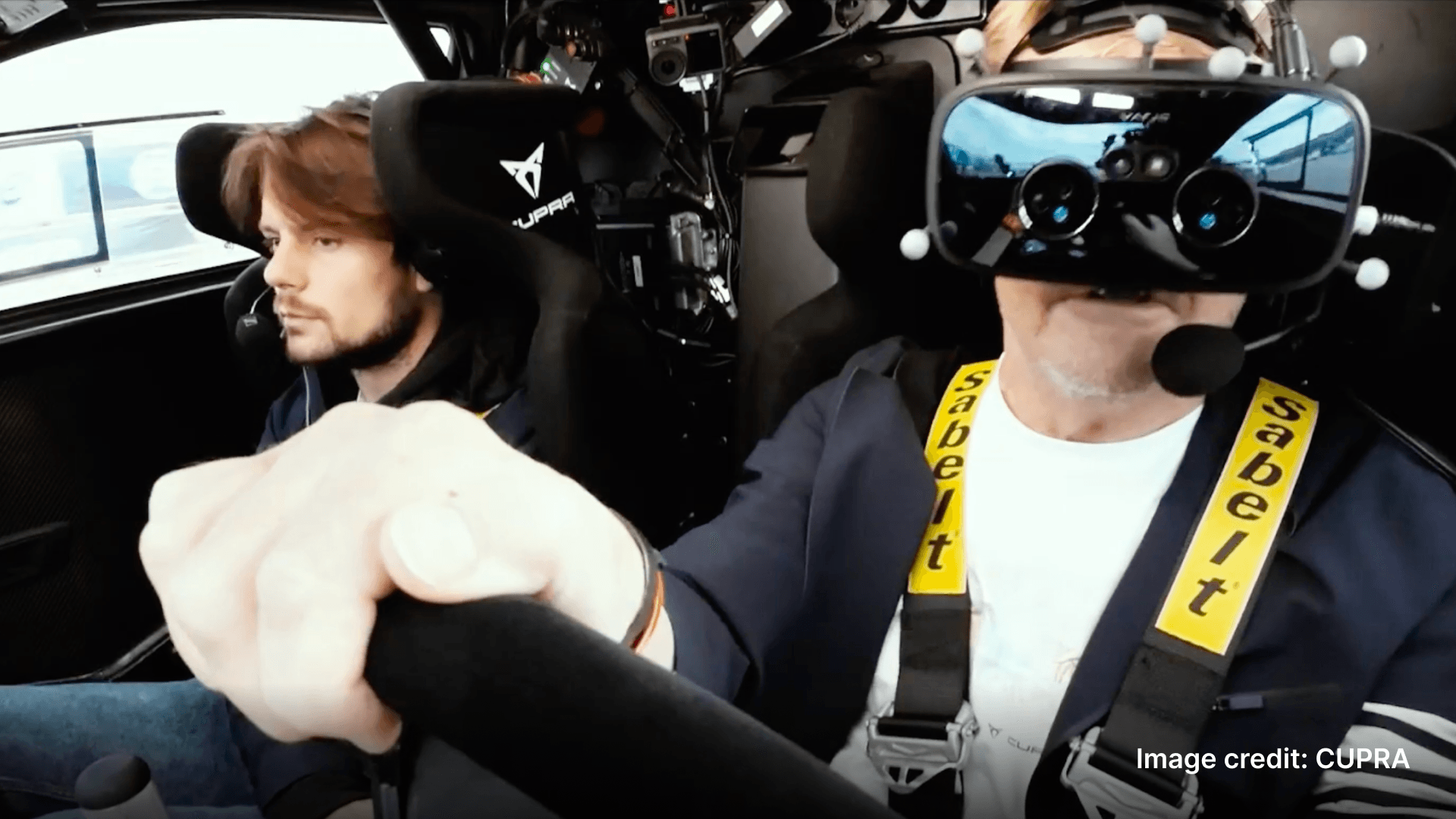
Mercedes-AMG F1 Academy Simulator in use

Mercedes-AMG F1 Academy Simulator in situ
In practice: the Mercedes-AMG F1 Academy Simulator
For the 2026 F1 Academy season, Unity partnered with Mercedes-AMG to create a static, engagement-focused touring simulator for iconic events including the British Grand Prix at Silverstone and the Las Vegas Grand Prix. The experience carries Mercedes-AMG branding and showcases the team's F1 Academy driver program. Unity supplied the real-time 3D platform. Cruden, a professional simulator manufacturer, built the simulator software in Unity.
“Everyone says, 'Oh, it's like the real thing.' It's just really, really cool to hear.”

Jasper Kort - Cruden
Senior Unity Pipeline & Integration Specialist
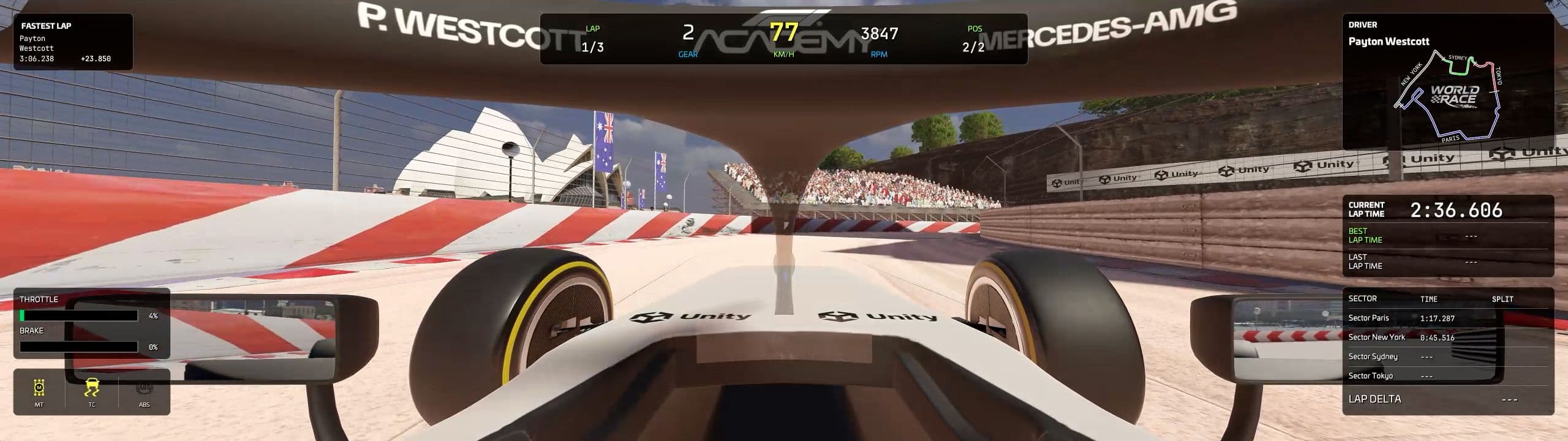
The centerpiece is a multi-city world tour track built entirely in Unity. The route spans several cities, so a single lap gives the driver the sensation of racing across global locations. HDRP delivered the PBR materials and lighting fidelity that make each city read as distinct, and it held up on the large, high-resolution displays wrapped around the cockpit.
What a simulator unlocks
Realism that lands on the first lap. When a user steps into a race car cockpit, the reaction is consistent and recognition is immediate.
Lap times close to the professionals. Simulator test drivers at one manufacturer recorded times close to what professional drivers achieve on the real circuit. This indicates a high level of accuracy in the visual and physics coherence.
A fan experience that travels. The Mercedes-AMG F1 Academy Simulator was built and deployed at major motorsport events, and it carries a live leaderboard.
Faster, safer driver practice. In a real car, a mistake means downtime, damage, and logistics. In the simulator, the driver resets in seconds. That buys more repetitions and deeper track knowledge, and it transfers to on-track performance.
Compressed engineering cycles. Automotive teams use Unity-based simulators to test handling, validate vehicle dynamics models, and evaluate setup changes in a controlled, repeatable environment. Work that takes days of on-track testing compresses into focused simulator sessions.
Where repetition is expensive, simulation pays
High-fidelity simulation earns its place wherever real-world repetition is slow, costly, or risky. A driver runs the lap again in seconds, an engineer tests a setup change without booking the circuit or waiting for a mechanic to make the change, a trainee repeats a difficult maneuver until it is routine. Motorsport engineering, automotive OEM development, and professional training all draw on the same pipeline, and the work that makes a race circuit convincing carries over to a vehicle program or a ship's bridge. The industry changes but the requirement does not.