Defining a unique visual identity for Starlight Re:Volver

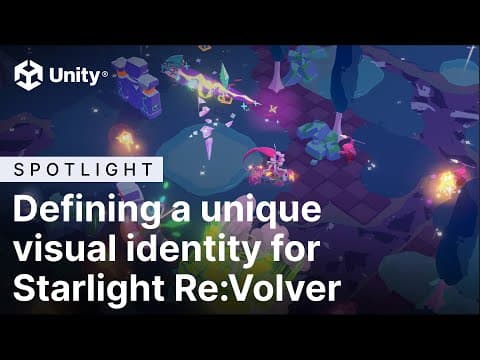
How do you make a game that feels like you’re playing an anime? Pahdo Labs founder and CEO Daniel Zou unpacks the design decisions behind the studio’s anticipated co-op action roguelite, Starlight Re:Volver – and reveals why, sometimes, rethinking your art direction halfway through development can be the right call.
Transcript
Daniel Zou, Founder and CEO, Pahdo Labs
Starlight Re:Volver is an anime role-playing game set in a dream world fantasy. It's a game where we want players to come together and engage in community, play minigames, and also self-express by decorating their characters and their homes as they like.
What sets Starlight Re:Volver apart is that it's an even mishmash of two different game genres that serve two different audiences. On one side, we have this roguelite RPG that's really deep, where the systems are very complex. On the other front, it’s a uniquely vibrant and colorful roguelite with really anime-inspired character designs. That's just something that, for core roguelite fans, it's not something that they've really seen before this point.
Roguelites are very intense and often, you can get fatigued playing run after run. And so we think that having this bright, fantasy world setting just makes the game more approachable and more palatable for folks. And then, of course, for folks that are introduced to gaming through cozy games and through their friends through social games, we thought that those players would really enjoy deep and complex systems as well as interesting decision-making. For a lot of those people, we're seeing that they're being introduced to the roguelite genre for the first time, and it's really enjoyable for them.
Standing out in the crowd
Reaching the social gamer has actually been quite a challenge for us. We found the number one reason a social gamer might pick up a new game is that their friend recommends it. And of course that's not exactly easy to control. What's in our control is making a product that we think is worth talking about, and that has sort of been a component in all of our decision-making, with the bright colors, the unique world hook, and so on.
The aesthetics and visuals for our game are something that we paid a lot attention to. It was really important, because we thought it was one of the key elements that would help us bring the roguelite genre to a wider audience through this vibrant, colorful, and anime- or toon-inspired art style. This was one of the reasons why we picked Unity, actually, because we found that the Universal Render Pipeline was more customizable and extensible.
We ended up using a lot of retro or old-school techniques that we found in retro games, or in Japanese games, and things like that. For example, with the shadows in our game, we use a technique called stencil shadows, which is a bit different than most modern games, which are using something called cascading shadow maps. Because we had this toon look with a top-down or isometric camera, this older technique allowed us to get much crisper toon shadows that make our game look that much better.
The other thing that we put in place was multicolored outlines. When you see outlines in a game, they're usually black, but we wanted to support blue outlines or red outlines inspired by some of the anime that we view as reference material. And it was also very easy to do that on Unity as well.
We also paid a ton of attention to the sound design and the music. When you load into the game and you hear the music playing, you instantly feel like you're transported into the world. Our composer is amazing. He personally has a lot of inspiration from Japanese works, he spent time in Japan, and so that all sort of plays a component in delivering on this sort of Japan- or anime-inspired fantasy.
Also, we wanted to make sure that our UI fit right in our world as well, and so we took a lot of inspiration from games like Persona to make a very stylish UI with strong shapes and really interesting silhouettes.
Handling unexpected pivots
About halfway through the project, we got to the point where we could start testing the game with players. I had this idea that with an anime-inspired art style, we could really move a wide audience. But what we found was, our art style wasn't polarizing enough – it wasn't getting people talking.
It made me think about something that Alijah, our creative director, said to me, which is that if you follow trends, you'll be late to the punch, so you have to make something from your heart.
We wanted to be very, I guess, product-minded and business-minded about it. We looked to the market to see, "Oh, what kind of anime might sort of be the best inspirations for our art style?" But what that didn't do was allow us to look into our own personal histories and our own personal preferences and find those reference materials, you know from 10, 20, 30 years ago, references from our childhood that really spoke to us. You know, not necessarily the ones that are the most popular today and use those as the inspiration for, you know our fantasy, our art style, our visuals.
And so we decided to scrap our art direction halfway through the project. And that was very tough. We redid every asset from scratch. And it was painful because it was scary and it felt like we had to catch up. But the studio, we all got through it and I think we're much stronger and better off for it.
Lessons learned
There are just too many games for regular consumers to comb through and digest. What they're really looking for is a game or a concept that they've never seen before. And in order to produce something like that, you really have to look away from the market and either more towards yourself or towards games that may have not been as popular and trying to reinvent those.
Knowing what I know now, I would tell myself to kind of trust my gut more and take advantage of the fact that the origin of this project came from a feeling from my own personal experience that there was something missing. And when you go in, you try to make a game, and you try to do it in a professional way, it's easy to forget that.
What I would tell myself is, from the very beginning, don't forget the reason why you went off and tried to make a game in the first place.
Add Starlight Re:Volver to your wishlist and get notified when it enters Early Access later this year. Find more Made with Unity titles on our official Steam Curator Page, and visit unity.com/resources for more content featuring Unity developers.

